The Panama Canal Is Latin America’s Chokepoint Story
The Panama Canal is Latin America’s clearest equivalent. It is not only a Panamanian asset or a shipping shortcut but a hemispheric logistics hinge that connects Asia, the United States, Latin America, and Europe through one narrow corridor between the Atlantic and Pacific.

Start your weekday with the Morning LatAm Signal email briefing.
A recent CSIS analysis of eight maritime chokepoints in the South China Sea offers a useful frame for Latin America.
The report argues that maritime chokepoints are not just shipping passages; they are strategic pressure points where trade, security, rerouting costs, and geopolitical leverage converge.
In 2024, CSIS estimates that nearly $6.4 trillion in goods passed through the South China Sea’s eight major straits, with the Malacca and Taiwan Straits each handling more than $2.4 trillion in goods.
The Panama Canal is Latin America’s clearest equivalent.
It is not only a Panamanian asset or a shipping shortcut but a hemispheric logistics hinge that connects Asia, the United States, Latin America, and Europe through one narrow corridor between the Atlantic and Pacific.
The Canal’s strategic value comes from compression: it reduces distance, concentrates trade flows, and turns water reliability, toll policy, port control, and geopolitical competition into business-risk variables...
The Panama Canal Is Strategic Risk Infrastructure
The CSIS South China Sea report matters for Latin America because it reframes chokepoints as infrastructure with geopolitical consequences. In Asia, the danger centers on conflict, blockade, or coercion around Taiwan, Malacca, and nearby straits. In Panama, the risk profile is different but equally strategic: water scarcity, toll policy, operational capacity, port control, and great-power rivalry.
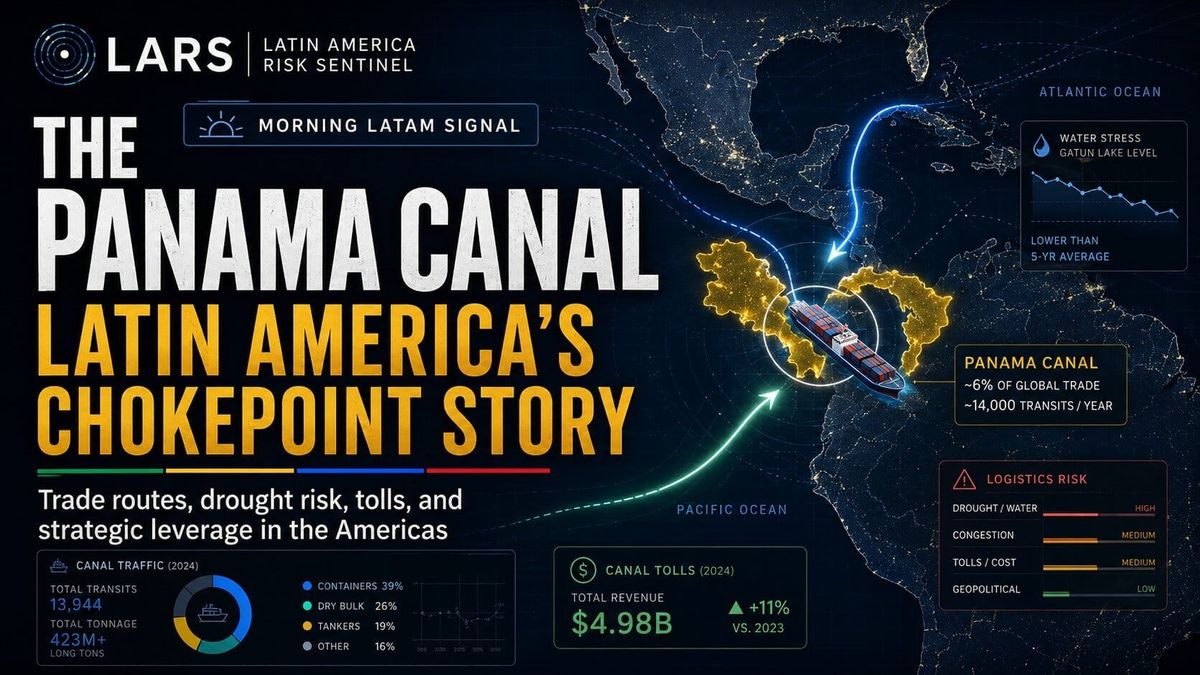
The Panama Canal saves ships from sailing around South America. Marine Insight notes that the Canal can reduce the Atlantic-Pacific journey by up to roughly 8,000 nautical miles, while a Canal crossing takes about 8 to 10 hours. The Panama Canal Authority also notes that the Canal’s location at the narrowest point between the Atlantic and Pacific has shaped trade patterns and saved distance and cost for routes such as the U.S. East Coast to Japan and Ecuador to Europe.
The Canal’s value is therefore not just physical. It is economic leverage created by geography.
Impact
This is not only a maritime story. It is a business-risk signal for supply chains, ports, exporters, insurers, commodity traders, energy shippers, and firms managing inventory across the Americas...
The Panama Canal Authority says the Canal connects 180 maritime routes, 1,920 ports, and 170 countries, with the United States as the top user country, followed by China and Japan. The Canal also reports that the main route by cargo tonnage runs between the U.S. East Coast and Asia, followed by routes linking the U.S. East Coast to the west coast of South America and Europe to the west coast of South America.
That makes the Canal a regional risk amplifier. When it functions normally, it quietly supports hemispheric trade. When it becomes constrained by water stress, toll pressure, congestion, or geopolitical friction, the consequences show up in freight costs, delivery schedules, rerouting decisions, and regional competitiveness.
Strategic Frame
The Panama Canal is Latin America’s chokepoint story because it turns geography into commercial power.
For Panama, the Canal is fiscal strength, sovereign influence, and strategic exposure. For Latin America, it is a logistics hinge connecting regional exporters and importers to the wider global trade system. For the United States, it is a core corridor for cargo tied to Asia and Latin America. For China and Japan, it remains part of the maritime architecture that connects Asian manufacturing and energy demand to the Americas.
This is why the Canal is best understood as strategic risk infrastructure. The infrastructure itself may be neutral, but the risks around it are not neutral. Water, tolls, ports, route reliability, and great-power competition all shape the cost and predictability of trade.
Core Signal
The Canal’s post-drought recovery does not erase the structural risk.
In FY2024, the Panama Canal Authority reported 5 billion PAB in revenue, 9,944 deep-draft ship transits, and 423 million tons transported, even after drought-driven operating constraints. The Authority said the drought reduced deep-draft transits by 21% from FY2023 and required draft and transit adjustments to preserve water resources.
By FY2025, the Canal had recovered strongly: 13,404 transits, a 19.3% increase from FY2024, and 489.1 million CP/SUAB tons, with container and LPG traffic among the main growth drivers.
That creates the central readout: the Canal is resilient, but resilience is not the same as immunity. Panama can manage through drought cycles, but business users will increasingly price the Canal as a variable risk rather than a fixed assumption.
Need-to-Know
The first signal is logistics.
The deeper signal is leverage.
The Panama Canal sits at the intersection of maritime trade, climate variability, U.S.-China competition, and Panama’s sovereign control over a corridor that global firms rely on. Its value rises when other corridors face pressure, as seen when disruptions around the Suez route and broader geopolitical tensions raise demand for alternative trade paths.
Reuters reported in May 2026 that the Canal was allowing 38 ships per day and did not plan passage restrictions for the rest of 2026 despite possible El Niño-related drought risks. The Canal Authority also said Gatún reservoir levels had been kept historically high through conservation measures.
That is positive, but it does not remove the watchpoint. The Canal’s operating strength now depends on water management, reservoir planning, and the ability to sustain throughput under climate stress.
Business Risk
This is a logistics-continuity signal and a geopolitical-risk signal.
Companies should not treat the Canal as a background utility. It is a cost, routing, timing, and political-risk variable. If transit capacity tightens, firms may face higher shipping costs, longer lead times, more expensive insurance, and pressure to reroute through longer alternatives.
The bigger mistake would be to see Panama Canal risk as “just Panama.”
The Canal affects trade routes linking the U.S. East Coast, Asia, the west coast of South America, the Caribbean, and Europe. That makes Canal stability relevant to firms operating in Colombia, Ecuador, Peru, Chile, Mexico, Brazil, and Central America.
Where the Risk Appears
Water systems: The Canal depends on freshwater, and drought can force transit and draft restrictions. That creates direct exposure for shipping lines, commodity exporters, and importers dependent on predictable delivery windows.
Tolls and costs: Higher fees, reservation systems, and auction mechanisms can raise costs even when the Canal remains open. Reuters notes that U.S. officials have complained about toll increases, while Canal fee structures apply by vessel type, size, reservations, auctions, and water surcharges rather than by flag or destination.
Geopolitical pressure: U.S.-China competition has made ports, bridges, logistics contracts, and canal neutrality more politically sensitive. Reuters reported that U.S. officials and lawmakers have raised concerns about Chinese and Hong Kong-linked firms near the Canal, while Panama’s government has emphasized that the Canal belongs to Panama.
Who Should Care
Logistics firms and shipping lines should care first because transit reliability shapes routing, vessel allocation, and customer delivery commitments.
Exporters and importers across Latin America should care because Canal delays or toll pressure can affect margins, inventory planning, and competitiveness.
Investors, insurers, and risk teams should care because the Canal is a proxy for broader risks: climate stress, infrastructure governance, maritime security, and U.S.-China competition in the hemisphere.
Forward View
Expect the Panama Canal to become more central, not less central, to Latin America risk analysis.
The Canal’s value rises when other trade routes are under pressure. Conflict risk in the Red Sea, uncertainty around Suez, and chokepoint competition in Asia all make Panama more important as a reliable Atlantic-Pacific corridor. At the same time, climate variability and water demand make the Canal more operationally complex.
Panama will likely keep investing in water management, capacity planning, and operational resilience. But external pressure will also increase. The more the Canal matters to U.S. trade, Asian trade, energy flows, and regional supply chains, the more it will become a political target during periods of strategic competition.
What to Watch
1) whether Gatún Lake levels remain strong through the next dry season and whether the Canal Authority can maintain high daily transit levels without returning to restrictions.
2) toll policy and reservation costs, because pricing pressure can affect shipping behavior even without a physical disruption.
3) U.S.-Panama-China friction around ports, infrastructure contracts, and neutrality, because the Canal’s strategic value depends not only on throughput but also on trust.