Brazil’s Tariff Shock Raises China-Competition Risk for U.S.-Linked Firms
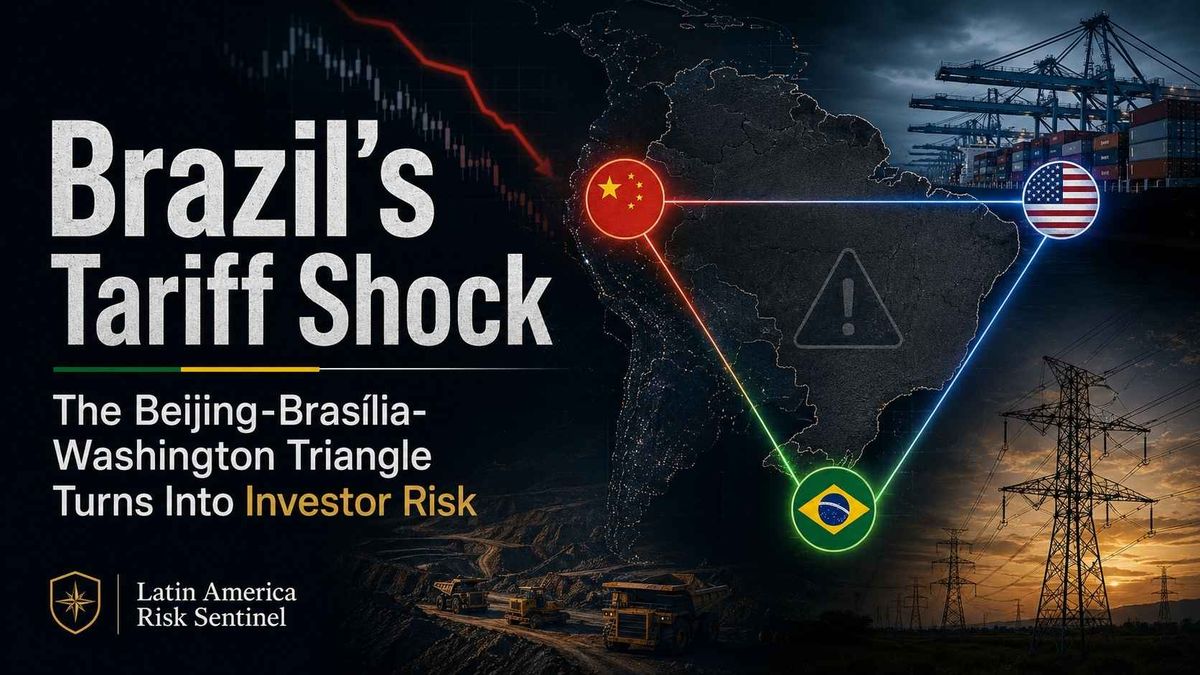
Washington’s proposed 25% tariff on Brazilian imports is likely to strengthen Lula’s case for deeper engagement with China, increasing competitive risk for U.S.-linked firms in Brazil’s strategic sectors.

Courtesy launch access: This briefing shows the kind of weekday risk analysis Sentinel Plus subscribers receive, with clear judgment on what happened, why it matters, and what to monitor in the trade dispute.
The continued Washington-Brasilia tariff fight is the trigger, but the investor signal is Brazil’s growing room to maneuver between Washington and Beijing.
Bottom Line
Washington’s proposed 25% tariff on Brazilian imports is likely to strengthen Lula’s case for deeper engagement with China, increasing competitive risk for U.S.-linked firms in Brazil’s strategic sectors. The risk is not an immediate U.S.-Brazil rupture. The risk is a gradual but deeper tilt in Brazil’s policy, capital, and industrial relationships toward Beijing.
Core Signal
The tariff fight is not only a trade dispute. It gives Brasília a political argument for resisting Washington and a commercial argument for treating Chinese capital as leverage.
Lula can frame the tariff threat as evidence that Washington is willing to pressure Brazil despite a trade relationship that is not clearly tilted against the United States. That matters because China is already expanding beyond commodity demand into sectors tied to Brazil’s long-term economic strategy.
The signal for investors is not that Brazil is choosing Beijing over Washington. The signal is that Chinese capital may become more useful to Brasília as the tariff fight sharpens.
Start your weekday with the Morning LatAm Signal email briefing.
Risk Path
- Washington: proposes a 25% tariff on Brazilian imports → gives Lula a sovereignty argument at home and a diversification argument abroad.
- Lula: frames the tariff threat as coercive U.S. treatment → gains political cover to deepen China engagement while still claiming strategic autonomy.
- Brasília: treats Chinese capital as leverage → creates stronger openings for Chinese firms in sectors where policy, financing, and market access matter.
- Chinese firms: expand beyond commodities into electricity, mining, autos, logistics, digital services, and consumer markets → gain stronger positioning in Brazil’s strategic economy.
- U.S.-linked firms: face a tougher competitive field → must track policy treatment, procurement signals, and sector partnerships, not only market demand.
Why It Matters
Brazil does not need to formally align with China for investors to feel the effect. A sector-by-sector tilt toward Chinese capital would be enough to alter competitive conditions in power, mining, autos, logistics, infrastructure, agribusiness, digital services, and consumer markets.
Brazil received $6.1 billion in Chinese investment in 2025, making Brazil China’s top global investment destination that year. Electricity led those flows, while mining investment tripled. That fact matters because the tariff dispute is landing after Chinese capital has already entered sectors that shape Brazil’s industrial policy and investor assumptions.
The business consequence is concrete. If tariff friction continues, investors should monitor whether Chinese firms receive more favorable treatment in procurement, sector partnerships, regulatory posture, market access, and long-term capital projects.
Brazil’s scale also gives the signal regional significance. Beijing is using Brazil’s resources, consumer market, industrial base, and Mercosur reach to deepen its influence across Latin America. That makes Brazil more than a bilateral partner. It makes Brazil a regional platform for Chinese commercial influence.
Start your weekday with the Morning LatAm Signal email briefing.
What to Watch
- Political Signal: Lula’s G7 messaging and the tone of his letter to Trump will show whether he frames the dispute as a narrow tariff negotiation or as evidence that Brazil needs more strategic autonomy from Washington.
- Escalation: Brazilian retaliation, delayed tariff talks, or new Chinese investment announcements in strategic sectors would show the tariff fight is feeding a broader China opening.
- Stabilization: A negotiated tariff pause paired with concrete U.S.-Brazil investment or market-access commitments would reduce the risk of a sector-by-sector tilt toward Beijing.
Decision Read
The investor signal is not that Brazil is breaking with Washington. The signal is that Washington’s tariff threat may make Chinese capital more useful to Brasília, and more dangerous to U.S.-linked competitors. That is where the Beijing-Brasília-Washington triangle becomes a market signal.
Trust Latin American Risk Sentinel to help mitigate yours and your clients' risks in the region.
LARS separates signal from noise for professionals tracking political, economic, market, security, and geopolitical risk across Latin America.
See more:
Get the Morning LatAm Signal: https://bit.ly/dailyb
Visit Latin America Risk Sentinel: https://www.latinamericarisksentinel.com/
Follow LARS on X: https://x.com/LatAmRiskIntel