Chile Walks Back 2030 Budget Goal as Debt Pressure Rises
Chile’s Finance Ministry has abandoned its goal of balancing the structural budget by 2030, shifting instead to a structural deficit target of 1.5% of GDP by the end of President José Antonio Kast’s term.

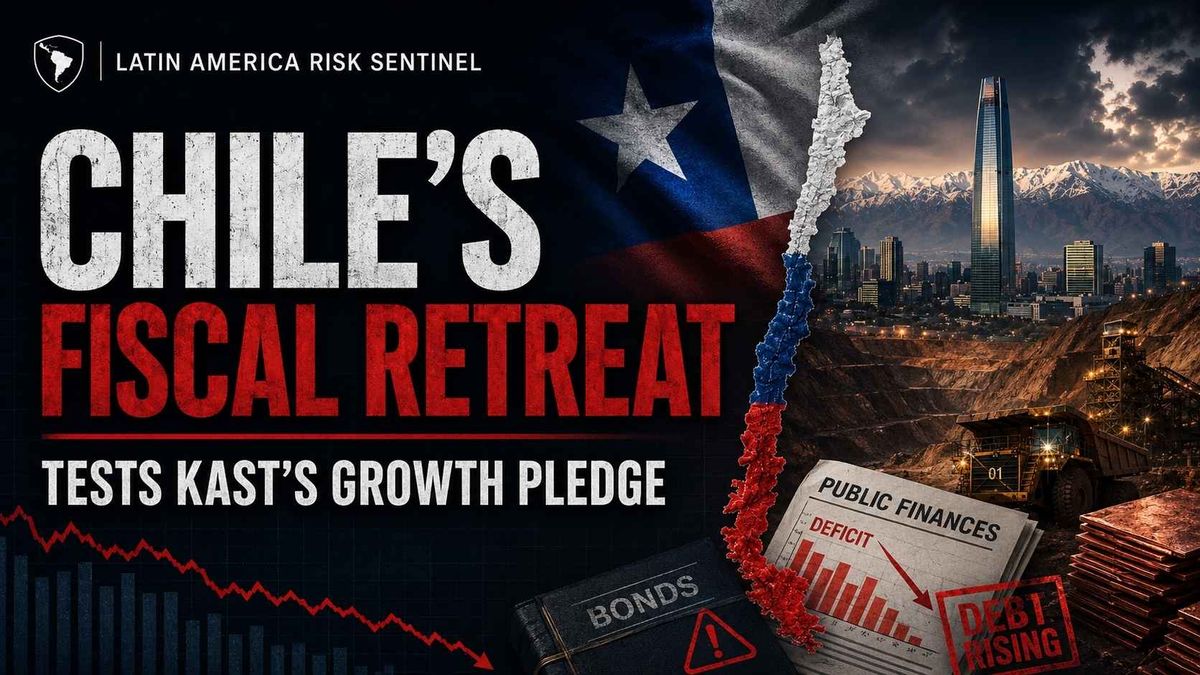
Chile’s Finance Ministry has abandoned its goal of balancing the structural budget by 2030, shifting instead to a structural deficit target of 1.5% of GDP by the end of President José Antonio Kast’s term.
The move shows the gap between Kast’s fiscal promise and the budget numbers now facing his administration.
The structural balance is Chile’s fiscal rule that adjusts the budget for the economic cycle, copper prices, and other temporary swings. It asks: what would the budget look like after stripping out temporary ups and downs?
The weak economy is the background, not the main story. The real signal is fiscal adjustment under pressure.
Chile is facing slow growth, weaker revenue, higher unemployment, disappointing copper production, and rising debt needs at the same time.
The government has already raised its fiscal deficit forecast, asked Congress for authorization to issue an additional US$6.2 billion in bonds, and announced US$2 billion in spending cuts.
Finance Minister Jorge Quiroz says the objective is to stabilize the debt trajectory and strengthen the state’s financial position, but he did not announce new expenditure reductions with the revised target.
Core Signal
The headline is not simply that Chile’s economy is slowing. Investors already know that.
The signal is that the slowdown is now forcing the Kast administration to revise its fiscal promise.
Kast came to office pledging to stop the state from spending beyond its means.
That made the structural balance goal politically important.
Walking it back so early is not a technical adjustment only but shows the gap between campaign fiscal ambition and the fiscal arithmetic now facing the government.
The new fiscal decree targets a structural deficit of 1.5% of GDP by the end of the presidential term.
The structural balance strips out cyclical effects in the economy which makes the change by the Kast administration important because the government is not merely blaming one weak quarter. It is acknowledging a slower path to fiscal stability ahead.
Quiroz was direct when asked whether the administration was admitting it would not reach the previous balance target. His answer was: “obviously, that’s what the numbers say.”
Risk Path
• Finance Ministry → drops the 2030 structural balance goal → Chile’s fiscal consolidation path becomes slower.
• Kast administration → shifts to a 1.5% structural deficit target → campaign promises meet weaker fiscal arithmetic.
• Government → asks Congress for US$6.2 billion in additional bond authorization → debt financing becomes more visible.
• Fiscal team → relies on spending rationalization, efficiency gains, and austerity → the burden shifts to implementation without new cuts announced.
• Weak economy → lowers revenue and raises social pressure → getting the public finances back under control becomes harder while unemployment remains high.
• Copper weakness → limits support from Chile’s key export sector → budget assumptions become more exposed to production and price swings.
Why It Matters
Chile’s reputation rests partly on fiscal discipline.
That reputation is now under stress.
The government is not abandoning fiscal control.
Quiroz framed the new target as a way to regulate the sustainability of public finances, stabilize the debt trajectory, and strengthen the state’s financial position.
The decree also maintains a medium-term gross debt anchor of 45% of GDP. That shows the administration still wants to preserve a rules-based fiscal framework.
The problem is that the adjustment is arriving alongside weaker economic data.
GDP contracted 0.5% in the first quarter of 2026. April activity fell 1.2% from a year earlier.
Unemployment reached 9.1%, with female unemployment at 10.5% and youth unemployment at 22.8%.
Chile has now recorded 40 months with unemployment above 8%.
Revenue pressure is also part of the inheritance from Kast's predecessor, Gabriel Boric.
The 2025 effective fiscal deficit reached 2.8% of GDP, above the 2.0% forecast, while non-mining tax revenue fell to 16.4% of GDP.
The previous government announced an $800 billion peso spending cut after tax revenue underperformed.
But now Kast must manage the economy for which he has proposed tax cuts, faster permitting, public-sector efficiency, and investment incentives to revive growth.
The question is whether those measures can raise activity quickly enough to support revenue while the state is already seeking more bond issuance.
The additional US$6.2 billion bond request is the clearest near-term pressure point that effectively lifts the debt ceiling by 36%, and it comes after the government raised its fiscal deficit forecast.
That does not make Chile a high-risk sovereign story but does mean the debt path deserves closer attention than it did when Kast’s campaign message was centered on fiscal correction.
What to Watch
• Budget Signal: whether the 2027 budget shows real expenditure restraint or depends mainly on future growth.
• Debt Signal: congressional treatment of the US$6.2 billion bond request and the credibility of the 45% debt anchor.
• Growth Signal: whether private investment, copper production, and monthly activity improve enough to support the new fiscal path.
Decision Read
Chile’s economy is weak, but the sharper business signal is fiscal retreat.
The Kast administration has moved from a structural balance promise to a 1.5% structural deficit target because the numbers no longer support the earlier goal.
For investors, banks, operators, and advisors, Chile remains one of the region’s stronger institutional economies.
If economic growth improves, the revised target may look like disciplined realism.
If growth stays weak, the revised target will look like the first step in a longer fiscal squeeze.