Chile’s Institutional Stability Belies Kast’s Rising Domestic Troubles
Chile’s small-business stress, household financial pressure, and rising public concern over crime are creating a tougher operating environment for President José Antonio Kast.

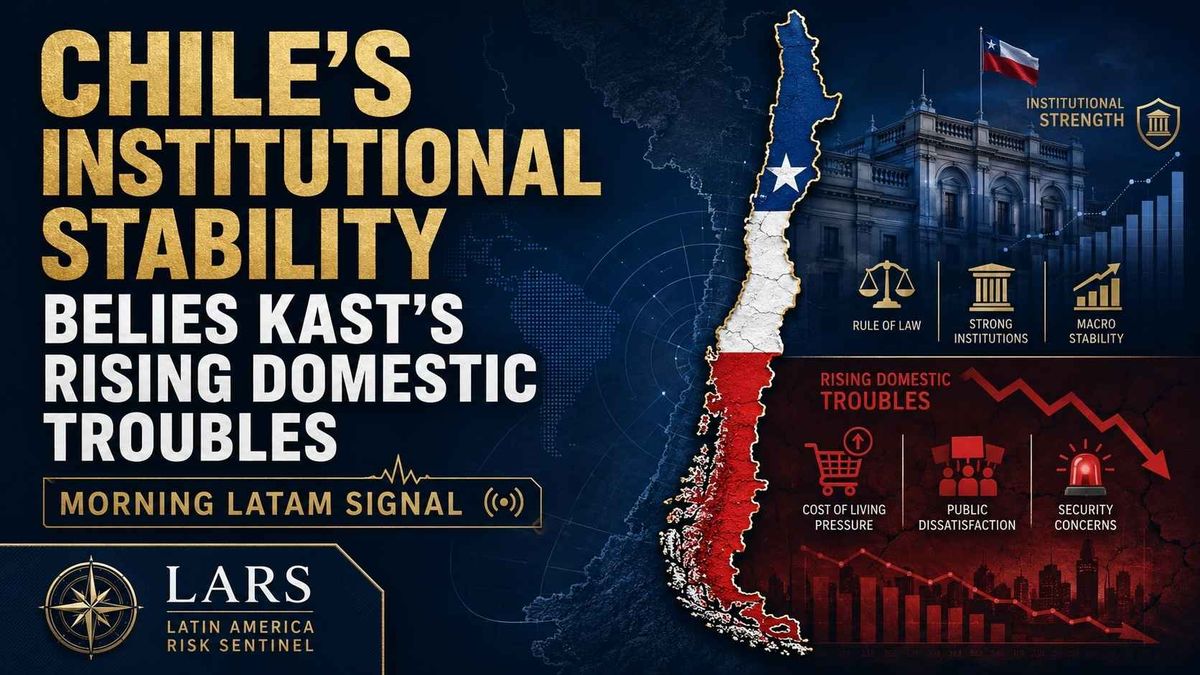
Chile still holds one of Latin America’s lowest country‑risk scores, but the stability implied by that ranking obscures a more complicated reality.
A decade of weakening investment, stalled growth, and rising social stress now intersects with record‑high concern over crime and a presidency losing political capital at speed.
The tension is the story: a low‑risk country facing high‑pressure risks.
Chile’s small-business stress, household financial pressure, and rising public concern over crime are creating a tougher operating environment for President José Antonio Kast.
Impact: The business signal is that Chile’s political mandate is running into a demand, employment, and security problem.
MiPymes are reporting weaker sales, higher cost pressure, and no appetite to hire, while public disapproval of the government is rising.
Watchpoint: Track MiPyme hiring, retail demand, wage-cost pass-through, fuel costs, public approval, security perceptions, and whether the government can convert its security agenda into visible economic confidence.
Chile’s economy is becoming a political-risk problem for President Kast.
Small firms are under pressure from weak sales, higher labor costs, fuel costs, and tighter financial conditions.
At the same time, citizens are giving the government weak marks on crime control and economic management.
The sharper signal is the overlap between household stress and business stress.
Consumer anxiety and small-business strain are high enough to affect confidence, hiring, spending, and the government’s room to govern.
Chile’s main signal that Kast's early administration is facing an economic-confidence problem before public-security confidence has recovered.
Economic strain and social pressure are now tight enough to squeeze Kast’s political space, turning early‑term stability into a governing liability.