Dominican Central Bank Holds Rate as Growth Recovery Faces Oil and Investment Risk

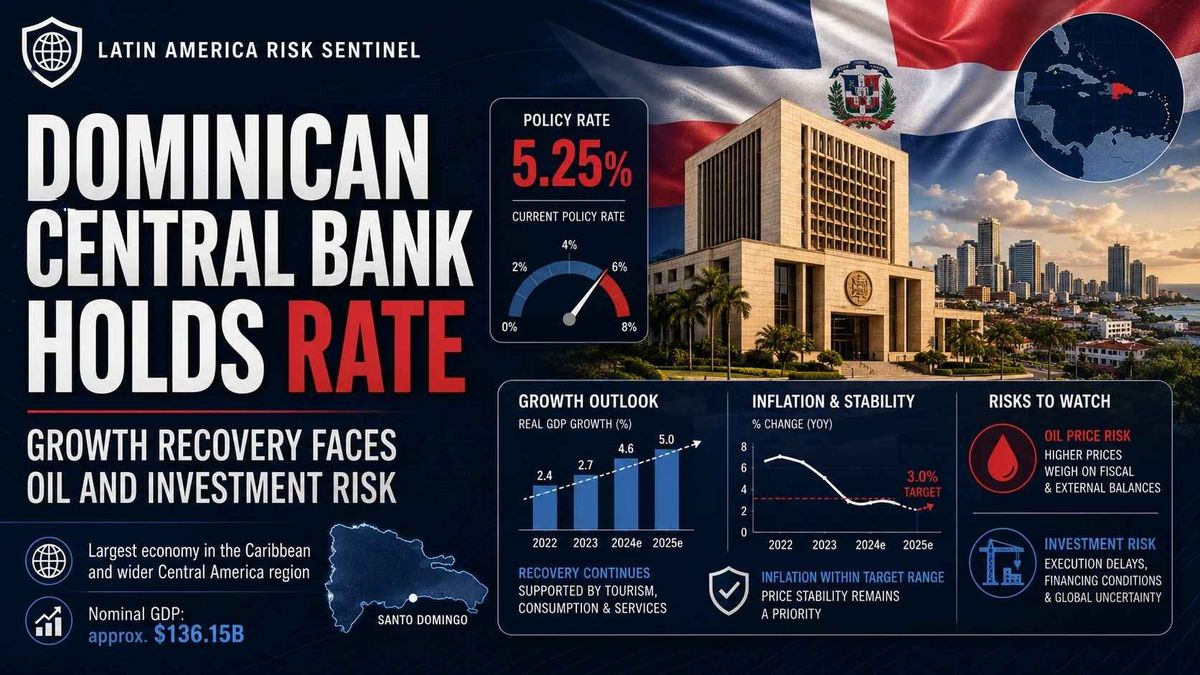
The Dominican Republic ranks as the largest economy in the Caribbean and wider Central America region with a nominal Gross Domestic Product (GDP) of approximately $136.15 billion.
The Dominican Republic’s recent (March 2026) monetary policy report sends a cautious but constructive signal: growth is recovering, inflation remains within the target range, and the Banco Central de la República Dominicana (BCRD) is holding its policy rate at 5.25% after easing in late 2025.
The BCRD projects real GDP growth of 3.5% to 4.0% in 2026 and 5.0% in 2027, supported by expected private investment recovery and a resilient external sector.
The risk is that the recovery depends on conditions the Dominican Republic does not fully control.
The BCRD says growth risks are tilted to the downside, while inflation risks are tilted to the upside.
Oil prices, Middle East conflict, persistent U.S. inflation, tariff-related price effects, and a slower private investment recovery could weaken the central scenario.
For investors and operators, the signal is not instability but conditional resilience.
Core Signal
The headline is policy stability.
The deeper signal is that the Dominican Republic is entering 2026 with a recovering economy, but the recovery remains exposed to external price shocks and domestic investment timing.
The BCRD’s baseline is positive: economic activity grew 3.5% year over year in January and 3.9% in February, after 2025 growth slowed to 2.1%.
The central bank attributed the 2025 slowdown mainly to weaker private investment, partly offset by the external sector.
That creates a commercially useful distinction. Dominican macro conditions are not flashing red.
But the next phase depends on whether liquidity support, lower market rates, and external-sector resilience convert into investment-led growth while inflation remains anchored.
Risk Path
- BCRD → holds the policy rate at 5.25% → preserves monetary caution while growth recovery remains incomplete.
- Private investment → slowed in 2025 and is expected to recover → weaker-than-expected investment would lower the 2026 growth path.
- External shocks → raise oil and inflation risks → BCRD policy flexibility could narrow if price pressures persist.
- BCRD liquidity program → channels RD$81 billion to productive sectors → credit conditions may support growth if firms convert financing into activity.
Why It Matters
For investors, banks, operators, and advisors, the Dominican Republic remains one of the region’s more constructive macro stories, but the BCRD report argues against complacency.
The economy is recovering from a slower 2025, and the central bank has already deployed liquidity support and macroprudential measures to ease financial conditions while protecting stability.
The practical business issue is timing. If private investment recovers as expected, the Dominican economy can move closer to its projected growth range.
If investment lags, the BCRD estimates growth could come in about 0.6 percentage points below the 2026 projection before gradually recovering toward potential in 2027.
Inflation is the second constraint.
The BCRD expects inflation to converge toward the center of its 4.0% ± 1.0% target range over the policy horizon, but it also identifies upside inflation risks from oil prices, geopolitical conflict, persistent U.S. inflation, and tariff-related pressures.
What to Watch
- Growth Signal: private investment data will show whether the projected 2026 recovery is gaining traction or staying dependent on the external sector.
- Inflation Signal: oil prices and food-price pressures will indicate whether inflation convergence remains credible.
- Policy Signal: BCRD rate decisions and liquidity guidance will show whether the central bank prioritizes growth support or inflation caution.
Decision Read
The Dominican Republic’s macro read is resilient, not risk-free.
The BCRD has room to support activity, but that room depends on inflation remaining anchored and investment recovering.
Decision makers should treat the country as a constructive market where oil prices, private investment, and policy caution deserve close attention.
LARS separates signal from noise for professionals tracking political, economic, market, security, and geopolitical risk across Latin America.
See more:
Get the Morning LatAm Signal: https://bit.ly/dailyb
Visit Latin America Risk Sentinel: https://www.latinamericarisksentinel.com/
Follow LARS on X: https://x.com/LatAmRiskIntel