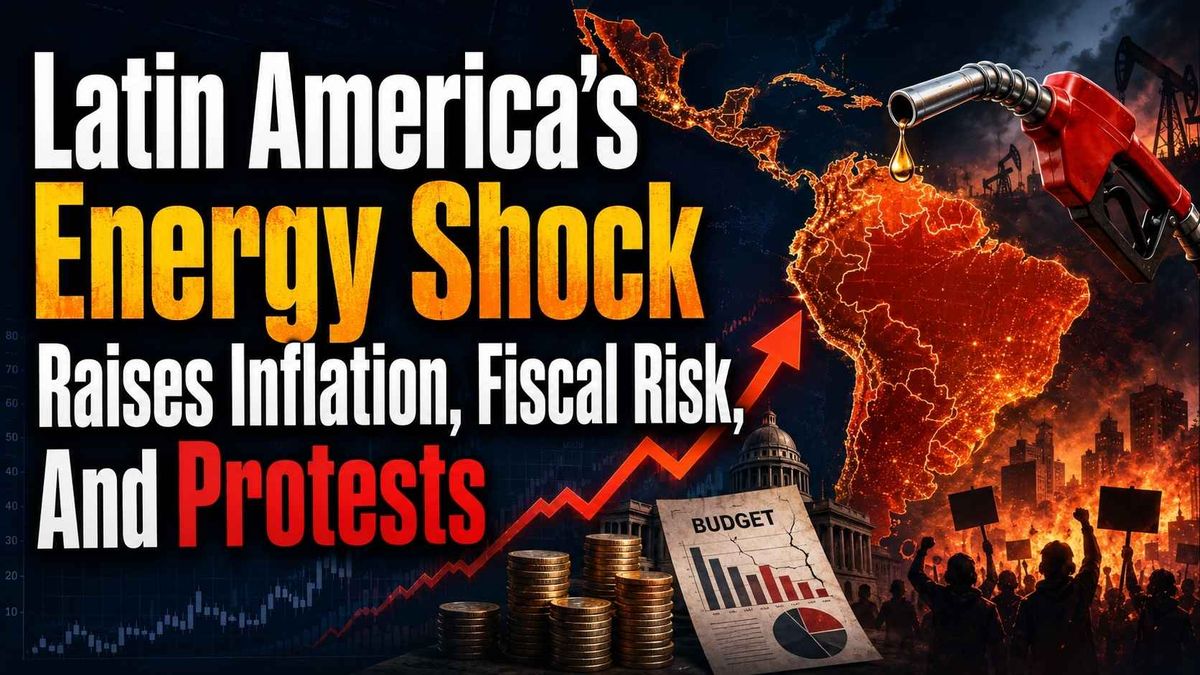
Latin America’s Energy Shock Raises Inflation, Fiscal Risk, And Protests
Even major hydrocarbon producers remain net importers of refined petroleum products, which leaves domestic prices, fuel subsidy programs, current accounts, and central bank decisions exposed when refined fuel prices rise.

Latin America is not facing a classic fuel-supply crisis from the Middle East conflict.
The sharper signals are inflation, fiscal costs, and political stability.
BNP Paribas assesses the region as less vulnerable than other emerging regions because most imported hydrocarbons come from the United States or within Latin America, while Argentina, Brazil, Colombia, and Ecuador are net hydrocarbon exporters.
The weak point is refined fuel.
Colombia’s 2023 gasoline protests and Ecuador’s 2025 diesel unrest show that fuel prices can weaken political stability even when the original shock is external or fiscal.
The 2026 risk is not that every country repeats those cases.
The risk is that higher refined fuel prices revive the same policy dilemma: pass costs through and risk unrest, or absorb costs through subsidies and weaken public finances.
Even major hydrocarbon producers remain net importers of refined petroleum products, which leaves domestic prices, fuel subsidy programs, current accounts, and central bank decisions exposed when refined fuel prices rise.
The risk now splits by policy model.
Chile and Peru are passing more of the shock into consumer prices, while Brazil, Mexico, and Colombia face a larger fiscal question through subsidies or state-managed prices.
Core Signal
The headline is energy, but the sharper risk is political stability.
Higher gasoline and diesel prices can turn an energy shock into protests, strikes, roadblocks, and pressure on governments to reverse policy or expand subsidies.
Latin America’s direct supply risk is limited because the region relies primarily on U.S. and regional hydrocarbon sources rather than on Middle Eastern supplies.
That reduces the probability of a physical shortage shock.
But limited refining capacity changes the business picture.
The region can avoid a supply rupture and still absorb a meaningful price shock through refined fuel imports.
Chile and Peru show the impact of inflation.
Their governments have not introduced fuel subsidies, and fuel prices have risen sharply.
Gasoline and diesel prices have increased by 31% and 60% in Chile, and by 43% and 65% in Peru, since the start of the conflict.
BNP Paribas notes that transport accounts for 12% to 13% of the CPI basket in those countries, making the inflation effect material.
Brazil, Mexico, and Colombia show the fiscal side of the issue.
Where governments limit the pass-through of fuel prices to domestic consumers, the cost shifts to public accounts.
Brazil’s subsidy cost is estimated at BRL 7.5 billion per month, broadly offset by BRL 8.5 billion in higher oil revenues, but election incentives could still increase fiscal risk.
Risk Paths
- Chile and Peru → pass higher fuel prices to consumers → inflation risk rises and central banks may need higher rates.
- Brazil → subsidizes fuel while receiving higher oil revenues → fiscal risk remains contained for now, unless election politics increase subsidy costs.
- Mexico and Colombia → manage domestic fuel prices through government policy → public finances may absorb more of the international fuel-price shock.
- Refined fuel import dependence → raises domestic fuel costs → governments face a tradeoff between fiscal credibility and social calm.
- Central banks → respond to domestic inflation conditions → companies face a higher-rate environment where inflation proves sticky.
Why It Matters
For decision makers, the practical risk is not whether Latin America runs out of fuel.
The practical risk is whether fuel prices alter inflationary conditions, fiscal choices, and borrowing costs.
Chile and Peru carry the clearer monetary risk.
BNP Paribas notes that Peru’s inflation rose from 2.2% in February to 3.9% in May, while Chile’s rose from 2.4% in February to 4% in April.
Higher fuel prices could make rate relief harder and increase debt-service costs, although both countries retain fiscal room because 2025 fiscal deficits were below 3% of GDP and interest payments did not exceed 8% of fiscal revenue.
Mexico and Colombia carry the cleaner fiscal warning.
Domestic fuel prices have barely adjusted in Colombia, and only modestly in Mexico, which means the gap between international and domestic prices may fall on the state.
BNP Paribas notes that subsidy costs in these countries may not be fully offset by higher oil-related fiscal revenue.
Brazil sits between the two models. Higher oil revenue helps offset subsidy costs, but the policy risk is political.
If subsidy spending rises, the fiscal benefit from oil revenue could weaken quickly.
What to Watch
- Monetary Signal: Chile or Peru rate decisions. Higher rates would confirm that the energy shock is feeding inflation risk.
- Fiscal Signal: Mexico or Colombia subsidy costs. Wider state absorption would indicate a higher risk of fiscal slippage.
- Market Signal: Currency weakness in Chile, Peru, or Uruguay. Renewed depreciation would show the refined-fuel import channel is straining external accounts.
- Political Signal: Higher gasoline prices without any government intervention can spark protests and lead to disruptions in key transport channels.
Decision Read
The business read is: Latin America’s energy shock is manageable while uncertainty lingers.
Consumers used to subsidized gasoline and diesel expect the same without interruption.
Decision-makers should track how each country manages its policy for fuel price stability because the same fuel shock poses different risks in Chile, Peru, Brazil, Mexico, and Colombia.
Should the Middle East conflict continue, and fuel prices ratchet higher, given fiscal constraints, other countries beyond Colombia and Ecuador may also see a surge of protests and attendant disruptions.