Mexico’s Growth Downgrade Challenges Nearshoring Narrative
Together, these signals show that nearshoring will not deliver stronger growth unless Mexico addresses the four constraints identified by Banxico and confirmed by international assessments — weak investment, weak activity, policy uncertainty, and inflation pressure.

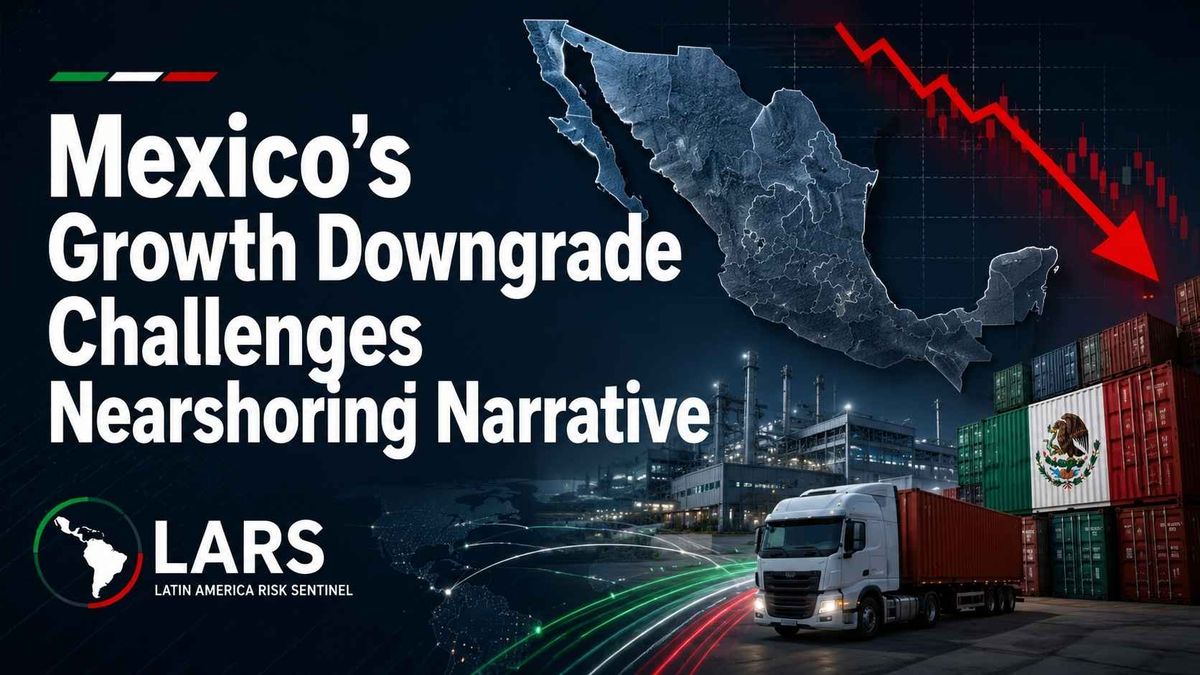
Banxico’s Informe Trimestral Enero–Marzo 2026 projected a weaker growth outlook that is now confirmed by international assessments from Moody’s, and the OECD.
The central bank cut its 2026 GDP forecast to 1.1% (from 1.6%) and narrowed the range to 0.5%–1.7%. It also reports that GDP contracted in the first quarter after late‑2025 improvement, while headline inflation rose from 3.69% → 4.13%.
In late May, Moody’s lowered Mexico’s sovereign rating to Baa3, projecting public debt will reach 55% of GDP by 2028, up from 40% in 2023, driven by structural fiscal deficits, rigid redistributive spending, and ongoing support for PEMEX and CFE.
Moody’s downgrade and debt projections confirm and reinforce the constraints Banxico identified in the Trimestral report.
The OECD reinforces the picture, cutting Mexico’s 2026 growth forecast from 1.3% → 0.8%, citing policy uncertainty, trade tariffs, and fiscal consolidation.
Together, these signals show that nearshoring will not deliver stronger growth unless Mexico addresses the four constraints identified by Banxico and confirmed by international assessments — weak investment, weak activity, policy uncertainty, and inflation pressure.
Start your weekday with the Morning LatAm Signal email briefing.
Core Signal
The signal is that the nearshoring continues to be under stress.
Banxico expects weak investment at least until the second half of 2026, driven by uncertainty around the U.S. commercial relationship and the upcoming T‑MEC review [the mandatory joint evaluation of the United States-Mexico-Canada Agreement (USMCA in English)].
For investors and operators, the question is no longer whether Mexico is well‑positioned; it is whether Mexico can convert location, trade access, and industrial depth into measurable activity before caution delays capital deployment.
Banxico describes an economy that contracted in Q1:
- Industrial activity reversed its late‑2025 recovery
- Services contracted
- Employment creation and labor participation remained weak
- Inflation rose, and the risk balance stayed tilted upward
This combination matters because the investment story is becoming conditional, not self‑executing.
Banxico still expects moderate growth, but it directly links investment weakness to U.S. trade uncertainty and the T‑MEC review.
Mexico remains strategically important, but the report nrshoring will translate quickly into growth.
Risk Path
- Banxico → cuts 2026 GDP to 1.1% → investors reassess whether Mexico’s supply‑chain advantage is converting into real activity.
- T‑MEC review uncertainty → delays investment → corporate commitments wait for clearer trade‑policy signals.
- Inflation above target → Banxico ends its rate‑cut cycle at 6.50% → limited monetary support for growth → debt‑trajectory deterioration raises sovereign‑risk costs as public debt climbs toward 55% of GDP.
- Middle East conflict → higher energy prices and global‑risk volatility → downside growth risk and upside inflation risk.
- Regional execution gaps → uneven industrial absorption → nearshoring outcomes vary sharply by state.
Why It Matters
For investors, operators, counsel, and advisors, Banxico’s report argues for a more selective Mexico read.
The country remains one of Latin America’s most important operating markets, but the growth downgrade challenges any lazy version of the nearshoring narrative.
The practical issue is investment timing.
If companies hesitate due to T‑MEC uncertainty, U.S. trade policy, financing conditions, or softer demand, Mexico’s strategic position can remain intact while growth underperforms.
That distinction matters for manufacturers, logistics firms, industrial suppliers, banks, and advisors tied to capital deployment.
The monetary backdrop reinforces the constraint.
Banxico paused in February, then cut by 25 bps in March and May, taking the reference rate to 6.50% and declaring the cycle that began in March 2024 concluded.
With inflation risks still tilted upward, Mexico faces weaker activity and limited room for policy support.
The decision point is whether project‑level assumptions still hold under weaker growth, delayed investment, and trade‑policy uncertainty.
Start your weekday with the Morning LatAm Signal email briefing.
What to Watch
- Policy Signal: clearer T‑MEC review messaging to reduce uncertainty and support investment timing.
- Market Signal: private investment data in 2H 2026 to confirm whether Banxico’s expected recovery is materializing.
- Monetary Signal: inflation moving toward the 3% target by 2Q 2027 to stabilize policy expectations.
- Operational Signal: industrial‑park absorption, electricity‑grid constraints, and permitting timelines in key states (Nuevo León, Coahuila, Chihuahua, Guanajuato).
Decision Read
The investor signal is not “avoid Mexico.”
The signal is “verify the execution path.”
Mexico remains strategically important, but Banxico’s report shows that location and trade access are not enough.
Decisionmakers now need closer tracking of:
- investment timing
- T‑MEC clarity
- inflation persistence
- policy restraint
- regional execution capacity
The boon of relocating manufacturing from Asia to Mexico has not been fully realized.
Banxico’s data compounded by fiscal deterioration and rising sovereign‑risk costs by Moody and the OECD only heighten the persistent challenges to that nearshoring narrative.
LARS separates signal from noise for professionals tracking political, economic, market, security, and geopolitical risk across Latin America.
See more:
Get the Morning LatAm Signal: https://bit.ly/dailyb
Visit Latin America Risk Sentinel: https://www.latinamericarisksentinel.com/
Follow LARS on X: https://x.com/LatAmRiskIntel