Nicaragua’s Brooklyn Rivera Death Exposes the Deeper Risk Inside the Managua Regime
The risk signal is larger than one prison death. Rivera’s case brings together political imprisonment, forced disappearance allegations, Indigenous rights, and state opacity. For principals watching Nicaragua, the issue is not whether the regime can maintain surface control...

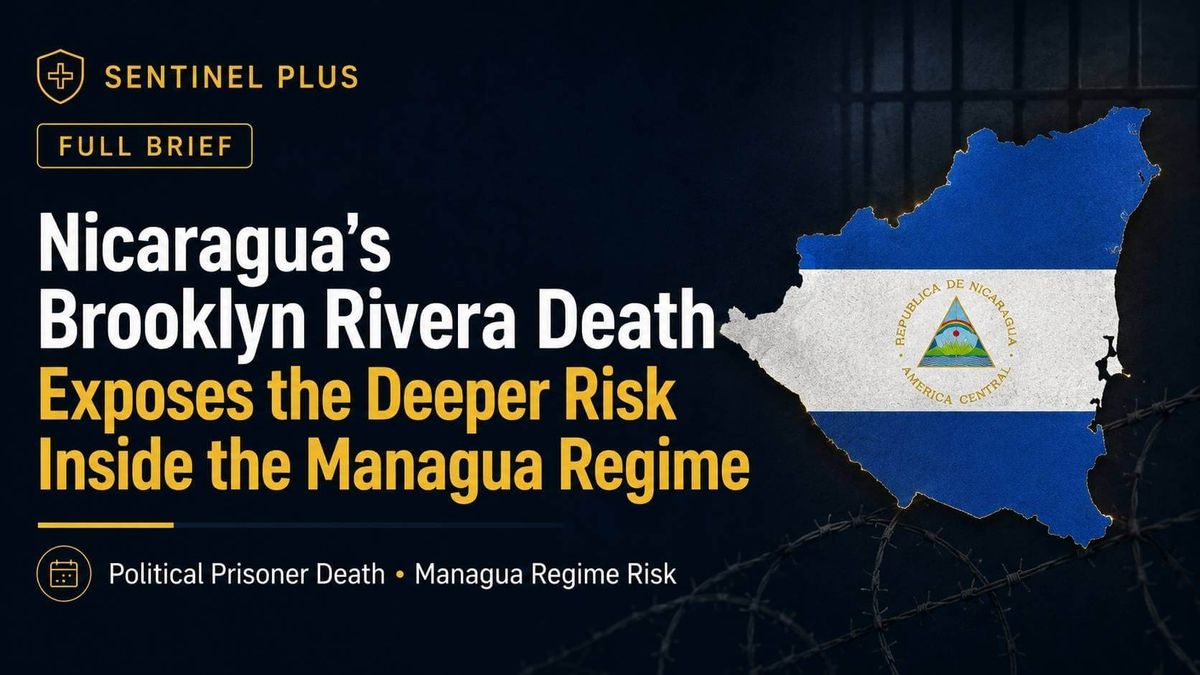
Courtesy launch access: This full Nicaragua briefing shows the kind of weekday risk analysis Sentinel Plus subscribers receive, with clear judgment on what happened, why Brooklyn Rivera’s death in state custody matters, and what to monitor as the Managua regime faces renewed scrutiny over political prisoners, Indigenous rights, and rule-of-law risk.
Brooklyn Rivera’s death in Nicaraguan custody is not only a human rights tragedy. It is a warning about how the Ortega-Murillo system manages political dissent, Indigenous leadership, and information control.
Rivera was a 73-year-old Miskitu leader and head of the Indigenous Yatama party. He died on May 30, 2026, after nearly three years in detention. Nicaragua’s government attributed the death to illness, but human rights groups dispute the official handling of his detention and custody. Amnesty International has called for a prompt, effective, and independent investigation. (The Rio Times)
The risk signal is larger than one prison death. Rivera’s case brings together political imprisonment, forced disappearance allegations, Indigenous rights, and state opacity. For principals watching Nicaragua, the issue is not whether the regime can maintain surface control. The issue is what that control costs, and how much legal, institutional, and reputational risk sits beneath it.
What actually happened
Rivera died after a long period in Nicaraguan custody. The Rio Times reported that he was arrested at his home in Bilwi in September 2023 and that authorities never publicly disclosed the charges against him. It also reported that he was at least the seventh political prisoner to die in state custody in Nicaragua since 2019, according to rights groups. (The Rio Times)
El País reported that Rivera died after more than 971 days of political imprisonment and forced disappearance under the custody of Daniel Ortega and Rosario Murillo’s regime. It also reported that the government confirmed his death more than 12 hours later and that his family sought the return of his body for burial in the Caribbean region. (El País)
Amnesty International said Rivera’s death followed health deterioration while he was arbitrarily detained, without confirmed whereabouts, family access, trusted legal counsel, or independent oversight. The organization said deaths in state custody must be investigated and called for an independent inquiry into the circumstances of his death. (Amnesty International)
Start your weekday with the Morning LatAm Signal email briefing.
Where the risk is being misread
The easy reading is that Rivera’s death is another tragic episode in Nicaragua’s human rights crisis. That is true, but incomplete.
The sharper risk is that Rivera’s death shows how the Managua regime can turn detention into a system of control. Custody removes the political actor. Silence controls the story. Delayed information limits outside pressure. That pattern matters for anyone assessing state reliability in Nicaragua.
The risk-reward asymmetry is also clear. Nicaragua can look stable from the outside because dissent has been suppressed. But quiet is not the same as stability. A country can appear politically controlled while its rule-of-law risk continues to rise.
That distinction matters for investors, counsel, NGOs, regional advisors, and companies with Nicaragua risk. A state that can disappear, isolate, or deny information about a prominent Indigenous leader is not a state where legal process can be assumed to operate normally when political interests are involved.
What will not change quickly
The deeper structure behind the Rivera case is unlikely to shift soon.
Freedom House rates Nicaragua as “Not Free” and describes the country as marked by the consolidation of public institutions under Ortega’s party, limits on fundamental freedoms, and repression after the 2018 anti-government protests. Its 2025 country report says the rule of law collapsed as the government responded to dissent with violence and repression, followed by surveillance, arrests of opponents, exile, and citizenship-stripping. (Freedom House)
That context matters because Rivera’s case sits inside a larger regime pattern. This is not a single dispute over detention conditions. It reflects a governing model in which political control weakens independent courts, civic space, and reliable access to information.
The Indigenous dimension also matters. Rivera was not only an opposition figure. He was a Miskitu leader tied to Yatama, a party defending Indigenous and Afro-descendant rights on Nicaragua’s Caribbean coast. The Rio Times reported that Yatama won a landmark Inter-American Court of Human Rights ruling in 2005 over Indigenous political participation rights. (The Rio Times)
For the next 12 to 24 months, the durable risk is the same: Nicaragua’s institutions are unlikely to provide neutral recourse when a matter touches regime security, territorial claims, local autonomy, or political opposition.
Start your weekday with the Morning LatAm Signal email briefing.
What to watch next
The first test is whether Rivera’s family receives his remains and complete information about his detention, medical condition, and death. Amnesty has said his family has the right to immediate and unrestricted access to information, along with the dignified return of his remains. (Amnesty International)
The second test is whether an independent investigation becomes possible. That would require access to medical records, custody details, and family testimony. Without that, the official account will remain part of the risk signal rather than a resolution of it.
The third test is whether the regime applies new pressure on Yatama-linked communities or Rivera’s family. Further intimidation would deepen the signal. A transparent process would reduce it. At this stage, the available evidence points more toward opacity than accountability.
Why this matters for your Nicaragua risk
For principals, the Rivera case is a rule-of-law warning. It shows how political risk in Nicaragua can affect custody, courts, information, and family rights at the same time. Those features also matter for business decisions because they reveal how the state may behave when a dispute becomes politically sensitive.
The legal and compliance angle is direct at the institutional level. A system that denies due process to political prisoners may also create risk for companies involved in public approvals, permits, state contracts, land issues, or local-community disputes. Rivera’s case does not create a commercial claim by itself. But it does signal the kind of state environment in which legal process may be subordinate to regime control.
That is the practical readout. Brooklyn Rivera’s death should not be treated as an isolated custody case. It is a severe Nicaragua risk signal because it shows the operating logic of the Managua regime: political control first, institutional transparency second, accountability last. For anyone managing Nicaragua risk, that order matters before any contract, project, or policy decision touches the state.
LARS separates signal from noise for professionals tracking political, economic, market, security, and geopolitical risk across Latin America.
See more:
Get the Morning LatAm Signal: https://bit.ly/dailyb
Follow LARS on X: https://x.com/LatAmRiskIntel