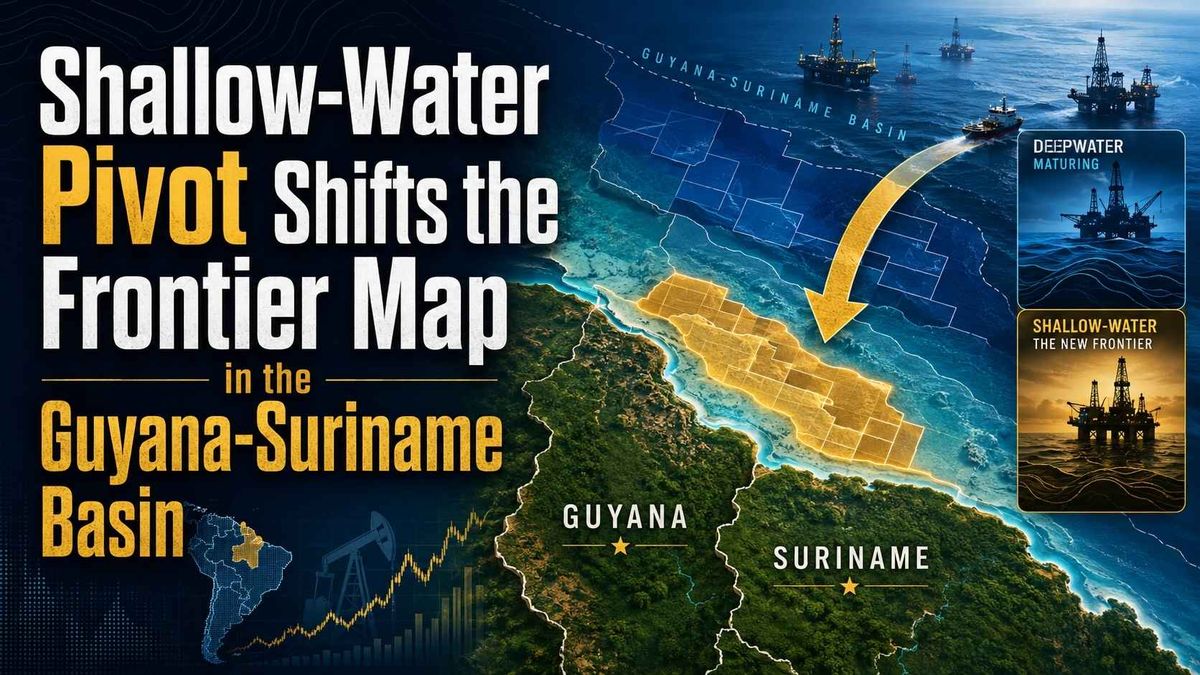
Shallow-Water Pivot Shifts the Frontier Map in the Guyana-Suriname Basin
While deepwater operations like TotalEnergies’ $10.5 billion Gran Morgu project anchor long-term volumes, the shallow-water pivot introduces a fast-tracked, lower-cost ecosystem that significantly lowers the barrier to entry for mid-size explorers.

Guyana has moved from oil discovery to major production with unusual speed.
The Stabroek Block remains the anchor, with roughly 900,000 barrels per day currently being lifted and a production forecast that could reach as high as 2.2 million barrels per day by 2030.
That matters because the global oil market is again assigning a premium to geopolitical risk.
However, a structural shift from deepwater megaprojects to nearshore, shallow-water exploration is accelerating across the Guyana-Suriname Basin, driven by standardized fiscal frameworks and lower-cost drilling timelines.
This transition is attracting mid-tier explorers and major international operators seeking manageable capital entry points.
Impact: This shift rapidly expands the commercial field for logistics, regional infrastructure tie-backs, and shallow-well engineering services, while introducing nearshore environmental and regulatory exposure across the basin.
Watchpoint: Monitor shallow-water block exploration outcomes, including Chevron's Korikori-1 results in Suriname's Block 5 and the advancement of Cybele Energy’s S7 block offshore Guyana.
Can Guyana escape the "oil curse" that has propelled the small nation of less than one million from deeply impoverished to the 11th richest country globally based on GDP per capita?
Subscribe to get the full report on Guyana's oil boom paradox.