The Shangri-La Signal: What Asia’s Security Debate Reveals About Latin America Risk
This dynamic is already visible. China is South America’s top trading partner and a dominant source of foreign direct investment...For executives, counsel, investors, and operators, the lesson is clear: never treat negotiations over Latin American infrastructure as a purely local story.

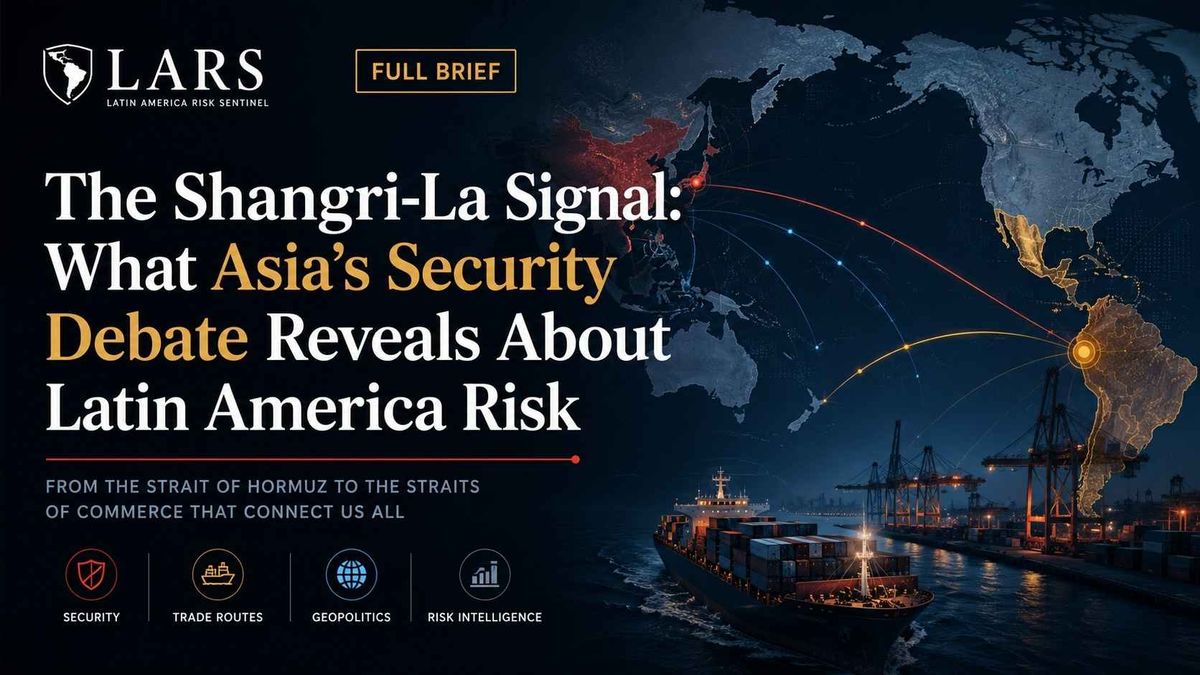
Latin America was not on the agenda at the recent Shangri-La Dialogue in Asia, but the strategic vocabulary used there applies directly to the region's risk profile.
The core judgment is clear: Latin America’s ports, minerals, power systems, telecoms, and diplomatic choices are being absorbed into a wider global contest, even when local headlines suggest otherwise.
Don't miss the business intelligence you and your clients need to mitigate Latin American risk.
The risk is not that Latin America becomes an Indo-Pacific military theater; it is that decision-makers continue to read the region's infrastructure and commodity stories too narrowly.
Three dimensions matter: the strategic signal, the regional application, and what to watch next.
1. The Strategic Signal
The Shangri-La speeches framed strategic stability as something far broader than a military balance.
- Multidimensional Instability: Malaysia’s Raja Dato’ Nushirwan described contemporary instability as a mix of geopolitical rivalry, technological disruption, cyber warfare, and resource strain. Crucially, he noted that strategic waterways carry profound commercial and security consequences without needing to be active flashpoints.
- The Governance Narrative: China’s Major General Meng Xiangqing added a diplomatic layer, arguing that the Global South deserves a stronger voice through institutions like BRICS and the Shanghai Cooperation Organisation. For Latin America, Beijing’s pitch is not just trade and finance—it is an alternative governance narrative offering leverage outside the U.S.-led order.
The takeaway? A region does not need to be the center of a crisis to become strategically vulnerable when global rivalry moves through supply chains and technology systems.
Start your weekday with the Morning LatAm Signal email briefing.
2. The Latin America Application
This dynamic is already visible. China is South America’s top trading partner and a dominant source of foreign direct investment. More than 20 Latin American and Caribbean nations have joined the Belt and Road Initiative (including Colombia), and Chinese state lenders have poured over $120 billion into the region since 2005.
Peru’s newly opened Chancay port perfectly illustrates this compounding risk:
- The Footprint: According to AidData, Chinese state-owned COSCO holds a 60% equity stake in Chancay, backed by a $975 million syndicated loan from Chinese banks secured against major project assets.
- The Integration: Chancay is not an isolated asset; it anchors China’s broader mining and transport footprint in Peru, linking operations like Las Bambas, Toromocho, and Marcona.
Chancay proves that port access, project finance, mining assets, and trade corridors can fuse into strategic infrastructure, granting Beijing leverage over commercial routes, data, lenders, and public authorities.
When a local commercial dispute becomes tied to U.S.-China rivalry, strategic risk escalates rapidly.
3. What to Watch Next
- Security Shift: Watch whether governments begin treating ports, minerals, telecoms, energy grids, and AI systems as national security assets rather than purely commercial operations.
- Chokepoints & Clauses: Watch Peru and Panama. In Peru, the port authority's attempt to annul Chancay’s exclusivity clause triggered warnings from Chinese lenders before a 30-year exclusivity compromise was reached. In Panama, anxiety persists over Chinese-linked port projects near the Canal.
- Interior Corridors: Look beyond the coast. China-backed infrastructure includes the roads, rail, and electricity grids connecting inland resources to export hubs. The analytical question is not just who owns the port, but who integrates the entire supply chain.
Start your weekday with the Morning LatAm Signal email briefing.
Decision Read
For executives, counsel, investors, and operators, the lesson is clear: never treat negotiations over Latin American infrastructure, mining, or telecoms as purely local stories.
Latin America’s importance is rising because it holds the vital assets of a fragmented world: routes, minerals, energy, food, data systems, and diplomatic votes.
Savvy decision-makers recognize that the region has become a critical front in the strategic contest between Beijing and Washington, and they partner with Latin America Risk Sentinel to safely navigate these shifting geopolitical shoals.
LARS separates signal from noise for professionals tracking political, economic, market, security, and geopolitical risk across Latin America.
See more:
Get the Morning LatAm Signal: https://bit.ly/dailyb
Visit Latin America Risk Sentinel: https://www.latinamericarisksentinel.com/
Follow LARS on X: https://x.com/LatAmRiskIntel