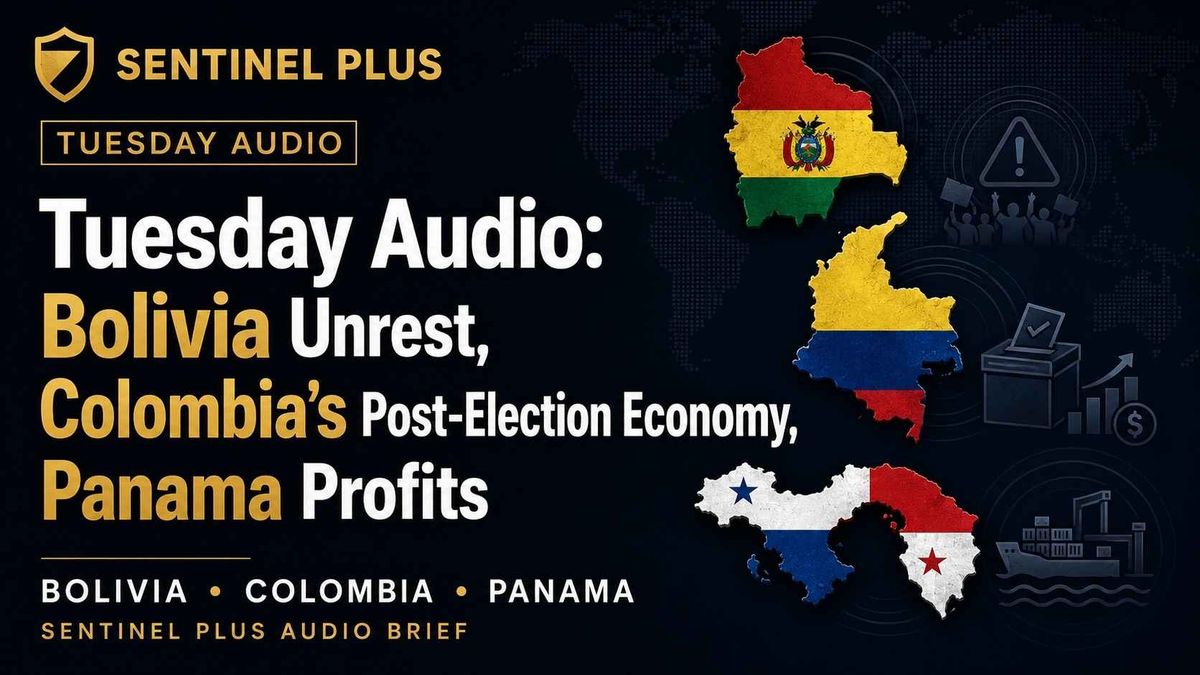
Tuesday Audio: Bolivia Unrest, Colombia’s Post‑Election Economy, Panama Profits
Colombia heads into its June 21 runoff amid sharp ideological polarization and widening fiscal stress, even after a pro‑market candidate topped the first round. And despite the fiscal pressure building under the surface, much of the country is looking toward the World Cup, not the balance sheet.

This is the Sentinel Plus full audio briefing, a report every paid subscriber gets on Tuesdays.
Count on Latin America Risk Sentinel for the need-to-know business intelligence you need to help you and your clients prosper.
Today, during our launch week, everyone gets complimentary access.
Your audio report next week is for premium subscribers only.
To become a paid subscriber for your in-depth look at 3 top issues impacting Latin America every week, just visit https://bit.ly/larsport
Introduction
Today, Bolivia, Colombia, and Panama are presenting decision-makers with three different kinds of regional risk.
Bolivia is nearing emergency-power territory as unrest, road blockades, and shortages strain President Rodrigo Paz’s government.
Colombia’s June 21 runoff is now a fiscal credibility test, with debt costs, inflation risk, and Banrep credibility shaping the next government’s room to act.
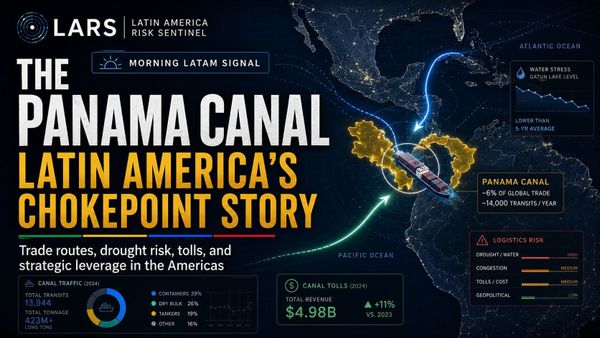
Panama is benefiting from the war in Iran as shipping traffic rises through the Canal, but water risk and capacity limits still set the ceiling.
BOLIVIA
Bolivia enters the week in a deeper phase of political rupture, less than a year after Rodrigo Paz won the country’s first-ever runoff transfer of power with a certified 55–45 victory — a mandate that was broad enough to win but too fractured to govern once shortages and blockades hit.
Evo Morales is intensifying the confrontation from the sidelines, calling for immediate elections even as he faces sweeping judicial cases, while the government accuses him of fueling destabilization amid a MAS split that never healed.
What’s unfolding now is a rapid breakdown of state capacity and political cohesion, where ideology, institutional mistrust, and collapsing social alliances have turned a fragile post-election landscape into a full legitimacy crisis.
Bolivia is most likely to remain in a phase of elevated political stress as protests, shortages, and internal fractures push the Paz government toward emergency‑powers territory, and the new reporting reinforces that this pressure is accelerating rather than easing.
· It is likely the government continues advancing the Law Regulating States of Exception as a legal shield for forceful road‑clearing.
· It is likely that blockades, shortages, and business disruption persist through the near term — now with a broader social base participating.
· It is unlikely that the Paz government collapses imminently, but likely that governance capacity continues to erode, especially as Morales escalates calls for early elections while facing major judicial exposure.
Strategic layer: lithium politics
Bolivia’s 23M‑ton resource base remains real, but it is most likely that production stays far below potential because the political and regulatory environment is not investable at scale.
· It is likely that Chinese and Russian lithium agreements face delay, renegotiation, or loss of privileged position.
· It is unlikely that China is pushed out outright, but likely that contract reviews weaken its advantage.
· It is most likely that investors face prolonged uncertainty around legal frameworks, contract stability, and operational continuity.
Risk channel: resource‑policy uncertainty + political convertibility
Watchpoints
· Whether a State of Exception is formally activated.
· Whether Congress advances lithium legislation or contract review.
· Whether blockades or shortages begin directly impairing lithium development.
Takeaway
Bolivia is most likely to remain a high‑uncertainty environment where the core risk isn’t lithium scarcity, but whether La Paz can maintain enough stability and investor confidence to turn its massive resource base into a real national treasure.
COLOMBIA
Colombia heads into its June 21 runoff amid sharp ideological polarization and widening fiscal stress, even after a pro‑market candidate topped the first round.
And despite the fiscal pressure building under the surface, much of the country is looking toward the World Cup, not the balance sheet.
The next administration will inherit rigid spending, high local yields, and a central bank guarding its independence — limits that will shape policy far more than campaign promises.
Colombia’s June 21 runoff is most likely to become a referendum on ideology rather than economics, though the two are related.
· It is likely that markets continue focusing on the 6.4%–7.8% deficit and the required 4%‑of‑GDP adjustment, regardless of who wins.
Colombia’s 4%‑of‑GDP adjustment is the size of the fiscal hole the next government must close — through some mix of spending cuts and new revenue — just to keep the country’s debt from rising.
· It is unlikely that either candidate can deliver rapid fiscal consolidation, given rigid spending (pensions, healthcare, transfers).
· It is most likely that debt‑service costs and high local yields (13.9%–14.8%) constrain early policy moves.
Monetary credibility: Banrep is likely to maintain a restrictive stance until inflation risk and election uncertainty ease.
It is unlikely that political pressure produces immediate monetary loosening. It is most likely that the next president influences Banrep gradually through board appointments, shaping medium‑term expectations.
Growth signal: It is likely that Colombia will continue to lean on consumption while investment remains weak. It is unlikely that investment rebounds without clearer fiscal direction.
Risk channel: fiscal credibility + monetary independence.
Watchpoints:
1. Runoff margin on June 21 - a stark choice to continue the leftist march under Presidente Petro’s favorite, Ivan Cepeda or a lurch back to the right with a controversial candidate Abelardo de la Espriella who now is the favorite.
2. Whether the winner presents a credible fiscal plan tied to the 4%‑of‑GDP adjustment.
3. Banrep’s June 30 meeting for the post‑election policy signal.
Takeaway: It is most likely that fiscal arithmetic — not campaign promises — sets the boundaries for Colombia’s next political cycle long after the cheering for La Seleccion in the World Cup has ended.
PANAMA
Since the Iran war erupted in late February, global shipping has been in a rolling state of disruption.
Even with a fragile ceasefire, operators are still diverting to safer, shorter routes and Panama is one of the biggest beneficiaries.
The question is how long the Canal can absorb the pressure.
Panama is most likely to continue benefiting from the Iran‑driven shipping realignment, but with a hard operational ceiling.
· It is likely that Canal traffic stays elevated (near 40–41 transits/day) as shippers pay for certainty.
· It is likely that revenues remain strong, with auction bids staying well above pre‑war averages.
· It is unlikely that this windfall becomes permanent without major reinvestment in water security and capacity.
Capacity and water constraints: It is most likely that physical limits (36–40 transits/day) and water levels remain the structural bottleneck. It is likely that maintenance windows and draft limits periodically tighten throughput. It is unlikely that Panama can expand capacity meaningfully in the short term.
Risk channel: operational resilience + water security.
Watchpoints:
1. Whether transits hold near 40–41/day.
2. Whether auction bids remain near or above $385k.
3. Rainfall, Gatún Lake levels, maintenance, or draft limits that tighten capacity.
Takeaway: Panama is most likely to keep monetizing global instability, but the strategic question is whether it can convert a short‑term windfall into long‑term resilience.
Final Readout
Bolivia shows how unrest and emergency‑powers drift can turn a world‑class lithium resource into an investor‑confidence problem.
Colombia shows how a runoff can shift political tone, but fiscal credibility — not campaign language — still defines the country’s operating boundaries.
Panama shows how global conflict can deliver a Canal windfall, but water and capacity constraints remain the ceiling on long‑term resilience.
Your audio report next week is for premium subscribers only.
Remember To become a paid subscriber for your in-depth look at 3 top issues impacting Latin America every week, just visit https://bit.ly/larsport
Thank you for listening to Sentinel Plus, and thank you for being a premium subscriber to Latin America Risk Sentinel.
I’m Winn Trivette II, your LatAm regional analyst.